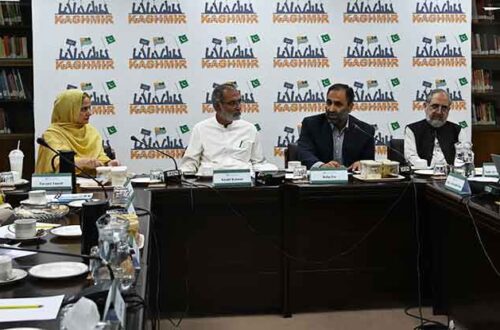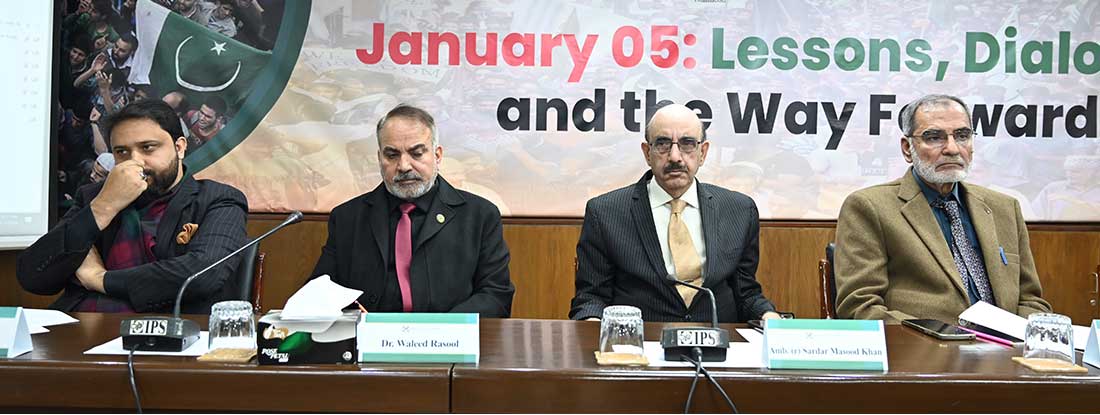


The ninth meeting of IPS-Working Group on Kashmir (IPS-WGK) was held on July 22, 2020, close to the conclusion of one year post Indian abrogation of Article 370 and 35-A in Jammu and Kashmir, and the consequent Kashmir siege forced on August 5, 2019.
Held as an annual review meeting, the sitting sought to analyze and summarize the findings and recommendations laid out by the Institute’s dedicated working group in their previous nine gatherings held across the year, and then compiling them in form of a consolidated policy brief (Click here to download the brief).
The meeting was chaired by Executive President IPS Khalid Rahman, and participated by Farzana Yaqoob, IPS associate and general secretary, IPS-WGK, Syed Mohammad Ali, senior research fellow at IPS, Ambassador (r) Syed Ishtiaq Hussain Andrabi, Ambassador (r) Tajammul Altaf, Brig (r) Said Nazir Mohmand, Raja Sajjad Khan, director, Jammu & Kashmir Liberation Cell (JKLC), Advocate Nasir Qadri, international law expert from Legal Forum for Oppressed Voices of Kashmir (LFOVK) and GM-IPS Naufil Shahrukh, among others.
The participants proposed the government to cohesively address Kashmir issue through six different aspects of political, diplomatic, psychological, legal internal law & law fare, economic, and strategic domains.
On the political front, it was stressed that all fundamental rights enshrined in the constitution should also be provided to people of Azad Jammu and Kashmir (AJK) and Gilgit-Baltistan (GB) and it should be given a provincial status for the purpose, while ensuring that no action is taken in the process of this arrangement that compromises the Kashmir cause by mentioning exclusively that these arrangements/amendments are provisional till the liberation of Jammu and Kashmir.
Diplomatically, it was recommended that all UN resolutions, reports and statements by relevant IOs like UN, UNHCR, genocide watch etc. should be consolidated, regularly updated, published on relevant websites, and shared globally by foreign offices in a bid to build pressure in support of sending and keeping UN observers in Indian occupied Kashmir.
Psychologically speaking, it was pointed out that since this is an era of narrative, Pakistan needs to build a strong, well-thought out narrative after internal discussions which should then be promoted globally through all available channels including think-tanks, academia, and mainstream and digital media.
In terms of legal internal law & law fare, the prospects of building and eventually filing a case against India for violation of the human rights at international court (IC) should be evaluated in detail and relevant law fare strategies should be considered in this respect. The legal right of the Kashmiri people to protect their lives, honor and properties recognized by international law and conventions and resist Indian occupation must be frequently highlighted, whereas stronger words like genocides, ethnic cleansing and war crimes should be used instead of softer words like human rights violations.
From the economic aspect, a case should be built under FATF for economic sanctions on those Indian businesses or commercial entities whose share holder and equity holder belong to RSS and individuals involved in human rights violation in IOK. Similarly, a case for considering visa restrictions on the travel, study, employment and business of those Indians who have been involved in any human rights violations in IOK or against minorities anywhere in India, should be gradually built via multilateral forums
In strategic and military domain, the concentration of Indian military within IOK should be reduced through an indirect strategy to provide relief to Kashmiri people and also reduce military threat towards Pakistan, AJK and GB. The situation in IOK also warrants high state of alert by Pakistani armed forces to ensure India does not conduct any military actions trying to divert diplomatic and political discussion away from the deteriorating situation in IOK. Greater cooperation between Chinese and Pakistani military in deploying training and exercises close to the IOK will also put greater pressure on India and reduce the risk of any Indian military adventure.
Last but not the least, the case of Kashmir that is to be presented internationally should not be confined to political speeches, slogans or tweets, instead a comprehensive work inclusive of data and facts should be incorporated into it, highlighting the Kashmir dispute in line with the Palestine issue before the global community.
It merits a mention here that these findings and recommendations of IPS-WGK were compiled in form of a policy brief titled ‘Jammu and Kashmir: One Year After August 5, 2019 and Way Forward’, which was then shared with the concerned stakeholders.