

The government of Pakistan has taken some good steps for raising awareness of the Kashmir issue internationally, but the lack of a comprehensive policy framework and a concrete action plan is hindering further progress considerably.
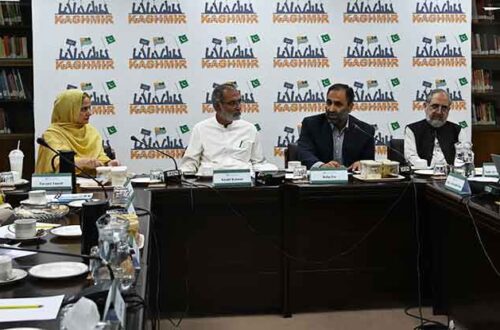
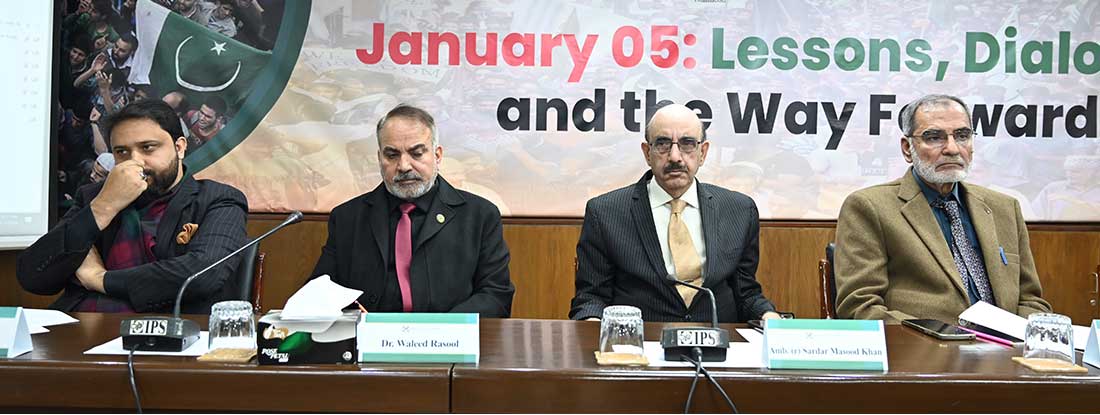
This was the gist of the sixth meeting of the working group on Kashmir, which was formed by Institute of Policy Studies (IPS), Islamabad to discuss the latest developments pertaining to Indian Occupied Kashmir (IoK) post August 5, 2019. The session, which was held on February 28, 2020, was chaired by Executive President IPS Khalid Rahman whereas the participants of the meeting included Ambassador (r) Syed Ishtiaq Hussain Andrabi, Farzana Yaqoob, former AJ&K minister, Ambassador (r) Syed Abrar Hussain, senior IPS research fellow, Amanullah Khan, former president, Rawalpindi Chamber of Commerce & Industry, Advocate Nasir Qadri, international law expert, and Dr Ayesha.
The panelists were unanimous that while the recent discussions on Kashmir with the UN Secretary General António Guterres during his trip to Pakistan and international media coverage of the issue do give an impression that Islamabad has gained considerable diplomatic ground in highlighting the dispute globally, but there is still a lot that needs be done in this regard. The absence of a comprehensive policy and a concrete action plan from the government conveys the sense that either it is not clear about any strategy or lacks the capacity to forge a solid response altogether.
It was pointed out that the actual situation in Indian Occupied Kashmir was much worse than what was being projected globally, whereas India is also preparing further ground to legalize its illegal act by altering the status quo. One can also not ignore the contemporary global scenario where all the nations and in fact the whole international system operates according to its own interests. Pakistan, in the given situation, must also realize the ground realities and try to devise a strategy to carve its way through the muddle.
The speakers were critical of Pakistan’s response so far stating that though a lot of activities were taking place in the country regarding Kashmir, they were not serving much purpose except creating a transitory memory at best. They emphasized that the onus of making use of the narrative formed as a result of those activities rests with the state institutions, but the paralysis of both policy and action at their end is only making the situation more perplexed. In case the concurrent inaction is being sustained as part of a policy, then it must be reflected as part of a plan. There are purposefully created Kashmir cells and committees within the government ministries, yet there is not a single layout consolidating a way forward strategy for Pakistan in the given situation, they added.
The speakers urged the government to build on the ground created by multifarious activities on Kashmir as well as the hype generated over the matter in international media. They viewed that the Kashmiri diaspora has played a very proactive role so far, but their motivation will waver if they don’t see any concrete response coming out of Pakistan. It is high time that the government starts to practice effective public diplomacy, and then instead of relying solely on sound bites, begins taking solid measures to exhibit a bit more determination for the cause.