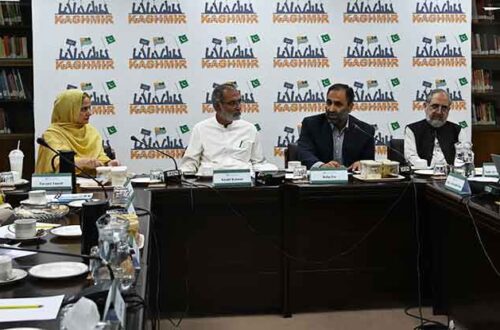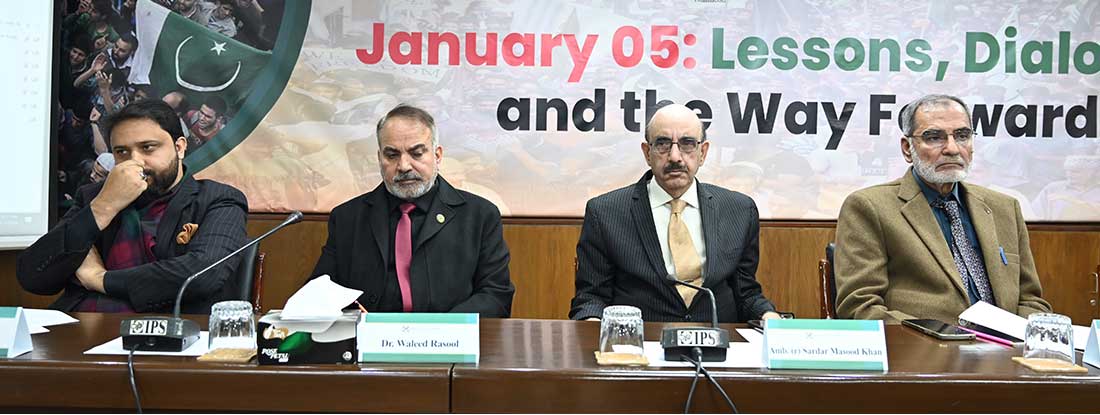


The seventh meeting of IPS’ Kashmir Working Group was organized online on May 18th 2020, with a view to study and analyze the contemporary relevance of the Karachi Agreement (signed between Pakistan, Government of Azad Jammu & Kashmir and its then only political party and resistance front, the Muslim Conference, in 1949).
The meeting was addressed as keynote speaker by Dr Idrees Abbasi, research scholar, Department of Sharia and Law, International Islamic University Islamabad (IIUI), whereas the main discussant was Bashir Khan Saddozai, former director Information, Karachi Metropolitan Corporation (KMC) and author of five books on Kashmir history and freedom struggle.
With IPS Executive President Khalid Rahman in chair, Farzana Yaqoob, IPS associate, former AJ&K Minister and Secretary IPS-WGK hosted the session. The participants included Ghulam Muhammad Safi, Hurriyat leader, Brig (r) Said Nazir Mohmand, Senior IPS associate, Advocate Nasir Qadri, international law expert, Shakil Turabi, chief editor, South Asian Broadcasting Agency (SABAH), Syed Muhammad Ali, IPS’ senior research fellow, and Naufil Shahrukh, GM operations.
Dr Idrees, while delivering his keynote speech titled ‘Karachi Agreement and Kashmir Issue: Contemporary Relevance’, presented the background of the Karachi Pact, apprising that the tripartite agreement was signed on April 30, 1949 as an international treaty between the sovereign governments of Pakistan, Azad Jammu and Kashmir (AJ&K) – which also represented Gilgit-Baltistan (GB) – to legally document the relationship between the three entities, especially for running civil administration and financial matters, as well as formalizing the division of governance functions among them.
The speaker was however of the opinion that a lot has changed over the decades ever-since, there is now a need to make some amendments and bring in new protocols both in the agreement as well as in the concerning constitutional framework of Pakistan with the consensus of all the current stakeholders including the GB government. Taking such measures, according to the speaker, will help strengthen the moral authority of the Kashmir cause especially while presenting the case before the international community.
Saddozai endorsed Idrees’ notion over the Karachi Pact, urging to bring much-needed amendments in the agreement while increasing the representation of AJ&K and GB in concerning platforms, especially the ones engaged in raising the Kashmir issue internationally.
Concluding the session, Khalid Rahman termed Idrees’ presentation very enlightening, stressing on the need of having more academic and intellectual dialogues over the topic while keeping in view other relevant documents like Karachi pact as well, all eventually aimed at strengthening our stance over the Kashmir cause by putting improved governance and legal structures in place.