Research

  • Twelve Seats: The Real Question in Azad Jammu and Kashmir

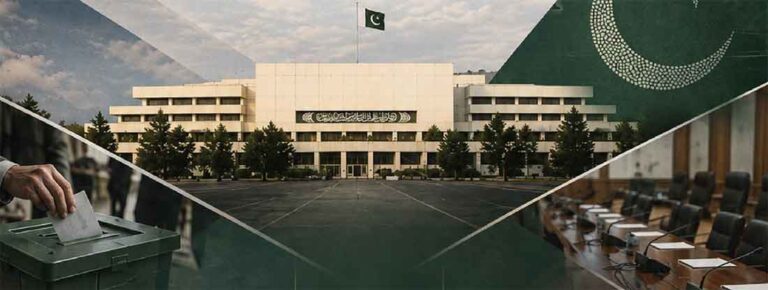
    This analysis by Dr. Umair Pervez Khan, member of the IPS Kashmir Working Group, examines the controversy surrounding the twelve seats reserved for Kashmiri refugees in the Azad Jammu and Kashmir Legislative Assembly. The policy insight explores the democratic concerns over their disproportionate electoral influence while highlighting the constitutional and political significance of maintaining representation for displaced Kashmiris. It argues that abolishing the seats would undermine Pakistan’s broader position on…

  • Bhagwat’s Political Signaling: Policy Recalibration or Political Space for the BJP?

    This analysis by Dr. Waleed Rasool, Senior IPS Associate, examines Mohan Bhagwat’s recent statements on Pakistan and their implications for India–Pakistan relations. The policy insight explores whether his softer vocabulary on dialogue and people-to-people engagement represents a strategic discursive recalibration rather than a formal shift in RSS policy. It considers the limits of India’s confrontational Pakistan policy, Pakistan’s growing diplomatic relevance, generational change, and the potential political space for renewed…

  • A Strategy of Political Marginalization to Structural Disenfranchisement

    This analysis by Iftikhar Gilani, senior journalist, examines India’s Special Intensive Revision (SIR) of electoral rolls and its implications for the country’s Muslim population. The policy insight traces the evolution of the BJP’s electoral strategy from Hindu consolidation and opposition fragmentation to the restructuring of the electorate through voter-roll revisions. It examines SIR’s expansion across Indian states, the large-scale deletion of voter names, and the potential consequences for politically significant…

  • Governance and Political System in Pakistan

    Pakistan is witnessing a broad political and policy debate on governance, with issues such as the creation of new administrative units or provinces, decentralization, local governments, and fundamental structural reforms once again coming to the fore. Against this backdrop, this report, “Governance and Political System in Pakistan,” prepared earlier by the Institute of Policy Studies (IPS) in collaboration with the Institute for Policy Reform and Research (IPRI), remains highly relevant…

  • Five Years On: Assessing Governance, Stability and Foreign Relations under Taliban Rule

    This analysis by Syed Abrar Hussain, Vice-Chairman IPS and the former ambassador of Pakistan to Afghanistan, assesses five years of Taliban rule, focusing on governance, economic survival, social restrictions, regional geopolitics, and relations with neighboring countries. The respective policy insight compares the incumbent Taliban administration with its previous rule, highlighting its greater administrative capacity, revenue generation, and regional diplomatic engagement, while noting the persistence of ideological rigidity, restrictions on women,…

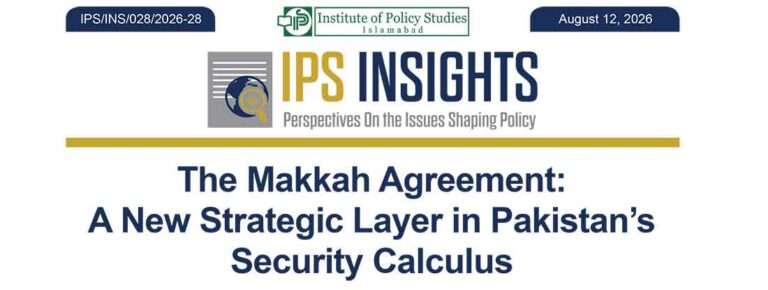
  • The Makkah Agreement: A New Strategic Layer in Pakistan’s Security Calculus

    This analysis by Brig (r) Tughral Yamin, Senior IPS Associate, examines the strategic significance of the Makkah Joint Defense Agreement signed by Pakistan, Saudi Arabia, and Türkiye and its implications for Pakistan’s security calculus. The policy insight explores how the trilateral pact adds another layer to Pakistan’s defense posture amid changing regional security dynamics and growing doubts about the reliability of the US security role in the Middle East. It…

  • Five Years On: Assessing Governance, Stability and Foreign Relations under Taliban Rule

    This analysis by Dr Lutfur Rahman, Senior Research Fellow at IPS, assesses five years of Taliban rule in Afghanistan from academic perspective, examining the balance between relative security gains and the country’s continuing domestic and regional challenges. The policy insight explores the Taliban’s reduction of large-scale violence and opium cultivation alongside Afghanistan’s worsening humanitarian conditions, healthcare and shelter needs, restrictions on women and minorities, and reports of extrajudicial killings. It…

  • From Gaza to Iran: Where Is the Dignified Way Out of War?

    This analysis by Masood Abdali, senior IPS Research Associate, examines the search for a political and diplomatic exit from the ongoing wars in Gaza and Iran. The respective IPS insight explores Hamas’s conditional willingness to disarm and relinquish administrative control in Gaza, the political dilemma facing Israel, and growing concerns within the US leadership over the limits of military action against Iran. It highlights the narrowing space for military solutions…

  • Pakistan–Saudi Arabia–Turkiye Defence Pact: Towards a New Regional Security Architecture or a Limited Strategic Understanding?

    The article analyzes the emerging Pakistan–Saudi–Türkiye defence pact, an extension of the 2025 Pakistan-Saudi SMDA, driven by waning trust in US security guarantees and rising Iranian threats. Pakistan brings manpower and nuclear deterrence, Türkiye adds defence industry and naval strength, while Pakistan also plays diplomatic bridge between Riyadh and Tehran. Though a mutual-defence clause exists, the author argues it falls short of NATO’s Article 5, likely activating only in specific…

  • The Changing Character of War: Towards a New Global Security Architecture

    This analysis by Said Nazir, senior associate, IPS, examines the changing character of modern warfare and its implications for the future of global security architecture. The policy insight explores how the Ukraine war, the Iran-US/Israel conflict, and the Gaza crisis have exposed the limitations of the traditional alliance-based security order and challenged the effectiveness of overseas military deployments. It highlights the growing role of missiles, drones, cyber capabilities, and hybrid…

Back to top