






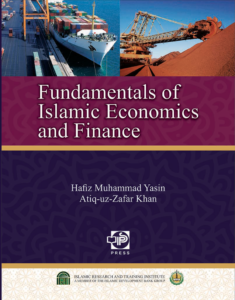
| Authors: Hafiz Muhammad Yasin & Atiq-uz-Zafar Khan Edition: 2nd (2018), 1st (2016) ISBN: 9960-32-289-0 Publisher: IPS Press Pages: 553 Price: 2200 Content: |
 |
About the Issue
Islamic Economics as a distinct discipline emerged in the last quarter of 20th century and the subject is now offered in many universities as part of the curriculum of economics at the undergraduate and graduate level. Although a few texts on introduction to Islamic Economics and finance are available in the market, this book is the first of its kind and nature.
Due to the rigorous research in this area over the past 50 years, a vast body of literature is available by now in different areas of theory and policy. However, this voluminous literature is scattered in hundreds of pages in thousands of different journals, books and manuscripts. There exist a significant number of institutions by now that cater for the cause of Islamic Economics and Finance, Islamic research and training Institute (IRTI) is no doubt playing a pioneer role in this respect. These institutions organize and conduct conferences, seminars, symposia and workshops in different parts of the world and the material presented is often available in published form. Obviously, access to this huge body of literature is much difficult for students, who are constrained to cover the prescribed course content and syllabi within the limited time frame of the semester. Furthermore, the said body of literature comprises the views of renowned scholars and practitioners, expressed in technical language, and these views are sometimes contrasting due to differences in the approach and coverage. As cited above, Islamic Economics and Finance is an emerging and yet expanding discipline, and as such we do not have a paradigm. This state of affairs may be confusing for young students and general readers. In fact, it is not possible for anybody, even for specialists in Islamic Economics, to digest all what is available in literature. This book is an attempt to present the important fragments in one volume, to explain the different concepts in simple words on which there is consensus among scholars, and to bypass the differences of opinion at this level. A comparative approach to the mainstream economics has been followed throughout for better understanding of the concepts. How far this attempt has been successful is left to the opinion of the readers.
