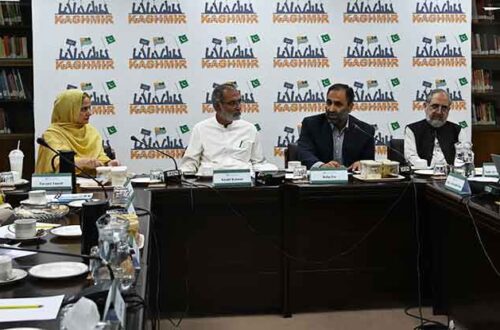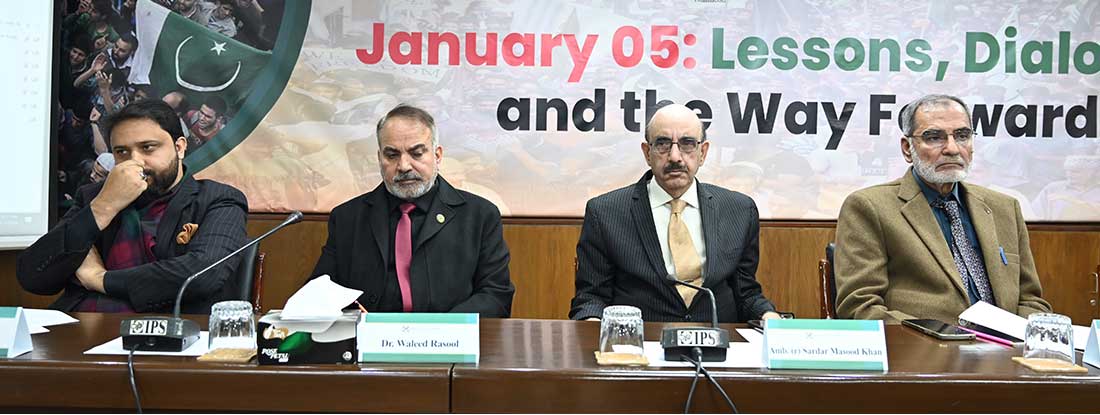




The thirteenth meeting of IPS’ Working Group on Kashmir (IPS-WGK) was held by the title ‘UN Resolutions on Kashmir and the struggle for IoJK’s right of self-determination’ on January 5, 2021.
The discussion was chaired by Executive President IPS Khalid Rahman, moderated by Farzana Yaqoob, IPS associate and general secretary, IPS-WGK, and addressed as keynote speakers by Raja Muhammad Sajjad Khan, director, Jammu and Kashmir Liberation Cell (J&KLC) and Advocate Nasir Qadri, human rights lawyer and president, Legal Forum for Oppressed Voices of Kashmir (LFOVK).
Giving a historical overview of UN resolutions on Kashmir, Khan stated that one of the main objectives of the UN was to ensure and protect the sovereignty of states and human rights. Unfortunately however, the international body has failed miserably to resolve the issue of Kashmir which has been put on the back burner by the UN since 1948; ever since India rushed to the United Nations Security Council (UNSC) in the wake of the conflict that had ensued in the occupied valley. He reiterated that UN resolutions on Kashmir are still binding on India and Pakistan, both of which are recognized parties to the Kashmir dispute, and thus India cannot take any unilateral decisions vis-à-vis the fate of Kashmiris.
The keynote speaker pointed out that the state of Jammu and Kashmir existed even before the partition of India on August 14, 1947, and even today the state enjoys unique cultural, historical and religious identity. Both Pakistan and India however have been looking at the region for the past seven decades as an issue that needs to be resolved.
Arguing about the efficacy of UN resolutions on Kashmir, Khan said these resolutions endorse the right of self-determination for the Kashmiris under international law, and maintain that the fate of Kashmir must be decided through democratic means.
Over the post 5-August 2019 scenario, Director J&KLC commented that Kashmiris never accepted the constitution of India as they have always upheld their demand of right for self-determination. India is now also trying to change the demography of the occupied valley after repealing its articles 35A and 370 and it is evident from its awarding of Kashmir’s domicile to Indian ex-servicemen. This however, he stressed, goes completely against the planks of international law.
Nasir Qadri argued that India has engaged Pakistan and Kashmiris for 30 years on the vague debate of whether Kashmir conflict is a dispute or an issue despite the fact that Kashmir is a classic case for a right of self-determination under international law. Qadri also underscored the need of recognizing the ongoing liberation movement in IoJK as a legitimate struggle under the prevailing oppressive circumstances.
EP-IPS Khalid Rahman said that Pakistan needs to strengthen its narrative on Kashmir where local people do not want to side with India, and make the world convince that the indigenous armed struggle waged by Kashmiris is just and legitimate in the light of international law. Pakistan on the other hand should maintain a well-devised, consistent and assertive stance on Kashmir issue that is unanimously upheld by the whole nation and is not affected by any change at the helm of affairs.