
• Pakistan-Afghanistan Relations: From Strategic Patience to Strategic Recalibration

    This analysis by Dr. Tughral Yamin, Senior IPS Associate, examines Pakistan-Afghanistan relations amid growing tensions over terrorism, border management, trade, refugees, and diplomatic mistrust. The policy insight explores the limitations of military pressure and the need to balance deterrence with dialogue, respect for sovereignty, and economic interdependence. It also assesses Afghanistan’s expanding regional relationships and China’s potential role in facilitating engagement. Importantly, the insight advocates reviving the Urumqi process as…
  • Beyond Tax Collection: Towards a Comprehensive Tax Policy for Pakistan

    This analysis by Zafar ul Hasan Almas, former Joint Chief Economist and Senior Research Associate, IPS, and Dr. Asim Ehsan, Senior Research Officer, IPS, examines Pakistan’s need for a comprehensive and transparent tax policy framework. The policy insight explores weaknesses in current tax practices, including reliance on indirect and regressive levies, administrative rule-making, and the exclusion of certain revenues from the divisible pool. It also assesses taxation against principles of…

  • Pakistan needs stronger institutions, actionable policies to address challenges: IPS forum

    Pakistan’s ability to address its complex national and international challenges depends on stronger institutions, improved governance, evidence-based policies, and effective implementation. At the same time, the country needs to anticipate opportunities in technology, agriculture, maritime affairs, regional connectivity, and its evolving strategic environment while addressing persistent social and economic concerns. These issues were discussed at the annual meeting of the National Advisory Council (NAC) of the Institute of Policy Studies…

  • IPS Chairman Delivers Lecture on Poverty Alleviation in Islamic Framework

    Sustainable poverty alleviation requires approaches that address not only the economic dimensions of poverty but also its broader social and ethical aspects. A values-based perspective rooted in the Islamic framework can complement conventional development approaches by offering principles aimed at addressing poverty on a sustainable basis. This was discussed by Khalid Rahman, chairman, Institute of Policy Studies (IPS), during a special lecture titled “Poverty Alleviation on Sustainable Basis in the…

  • Iran-US War: Strategic Dynamics, Constraints, and the Elusive Endgame

    This analysis by Said Nazir, Senior IPS Associate, examines the strategic dynamics, constraints, and uncertain endgame of the Iran-US war. The policy insight explores US war aims, Iran’s asymmetric strategy, the strategic importance of the Strait of Hormuz, and the economic and political costs of the conflict. It also assesses the limitations of American military power, global commitments, and the absence of a viable ground-war option. Importantly, the commentary highlights…

  • Pakistan’s Economy in Fiscal Year 2025-26: Macroeconomic Stabilization and the Challenge of Sustainable Growth

    This analysis by Zafar ul Hasan Almas, former Joint Chief Economist and Senior Research Associate, IPS; and Dr. Asim Ehsan, Senior Research Officer, IPS, examines Pakistan’s economic performance during FY2025-26, highlighting significant macroeconomic stabilization alongside persistent structural vulnerabilities. The policy insight assesses economic growth, fiscal consolidation, inflation, investment, public debt, and external-sector performance. It notes that while lower inflation, a reduced fiscal deficit, and higher foreign-exchange reserves indicate improved stability,…

  • From Makkah to Istanbul: Turning a Defense Pact into a Strategic Alliance

    This analysis by Tughral Yamin, Senior IPS Associate, examines the Istanbul meeting of Pakistan, Türkiye, and Saudi Arabia and its significance for transforming the Makkah Joint Defense Agreement into a functioning collective security mechanism. The policy insight explores the institutional, military, financial, and diplomatic arrangements needed to make the agreement credible, including command structures, intelligence sharing, joint exercises, and defense-industrial cooperation. It also assesses the Iran-US conflict, the India factor,…

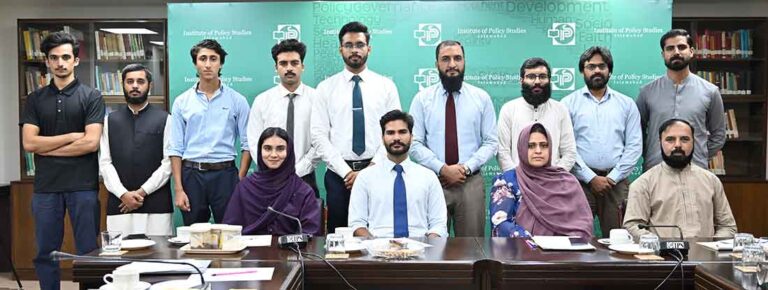
  • IPS inducts Aman Council into Next Gen Network, hosts session on Alternative Dispute Resolution

    The Institute of Policy Studies (IPS) formally inducted the Aman Council, a student-led initiative focused on amicable dispute resolution, into its Next Gen Network at an event held on August 27. The session also featured presentations by Aman Council members on Alternative Dispute Resolution (ADR), providing an opportunity for academic engagement and discussion on the subject. The Aman Council was formed by students of the Shaybani Law Society (SLS), Department…

  • New Administrative Units in Pakistan: An Economic and Financial Context of the Debate

    This analysis by Zafar ul Hasan Almas, former Joint Chief Economist and Senior Research Associate, IPS, and Dr. Asim Ehsan, Senior Research Officer, IPS, examines the economic and financial implications of creating new provinces or administrative units in Pakistan. The policy insight focuses on five key considerations: resource-transfer mechanisms, the cost of new governance structures, tax administration and the divisible pool, borrowing and contingent liabilities, and the timing of reform.…

  • From Makkah to Tehran: Can Pakistan Bridge the Gulf’s Deepening Security Divide?

    This analysis by Tughral Yamin, Senior IPS Associate, examines Pakistan’s diplomatic role amid the deepening security divide between Iran and the Gulf states. The insight explores Field Marshal Asim Munir’s Tehran visit, the emerging Makkah Joint Defence Agreement, and the possibility of incorporating Iran into a broader regional security framework. It highlights the challenges posed by the Saudi-Iranian rivalry, the Houthi issue, and US strategic interests, while assessing Pakistan’s unique…

Back to top