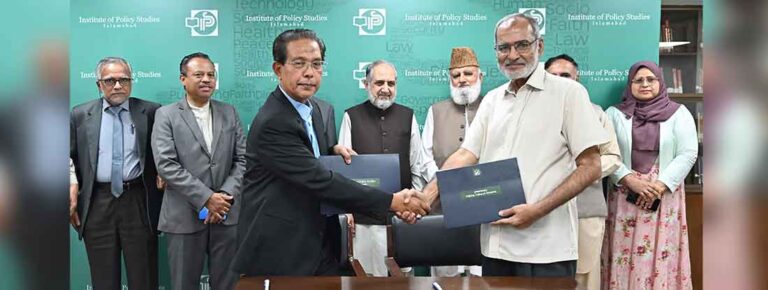

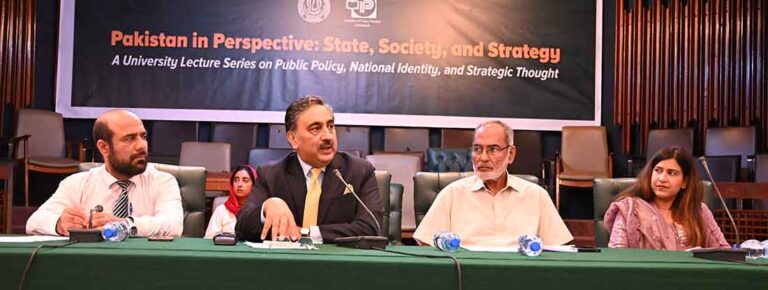
• Informed understanding of Constitution, international law vital for Pakistan’s global role: Ahmer Bilal Soofi

    Pakistan’s constitutional identity, commitment to international law, and responsibilities in the global arena require informed academic discussion, particularly among the younger generation. A clear understanding of the country’s constitutional foundations, international obligations, and diverse strengths is essential for developing an informed perspective on Pakistan’s role in the contemporary world. This emerged as the central theme during a lecture titled “Pakistan in Perspective: Constitution, State & Global Responsibilities,” the second in…
  • Greenland: A New Piece in the Global Security Chessboard

    This Policy Insight by Dr. Tughral Yamin examines the emerging strategic significance of Greenland following the agreement between the United States, Denmark, and Greenland. It explores how expanded US security access could reshape the Arctic’s military architecture, North Atlantic security, and the strategic balance involving Russia and China. The analysis also considers Greenland’s critical minerals, the evolving role of NATO, and the implications for transatlantic relations. Importantly, it highlights the…

  • Pakistan-China Boundary Joint Commission

    This Insight analysis by Dr. Tughral Yamin, Senior IPS Associate, examines the operationalization of the Pakistan-China Boundary Joint Commission (BJC) and its significance for managing the increasingly important frontier between the two countries. It explores the commission’s role in border management, trade and connectivity, the Khunjerab crossing and CPEC, while also considering its wider regional and geopolitical context. Download PDF

  • Stronger strategic ties among Muslim countries urged amid changing global order: IPS-IAIS

    The changing international system and growing geopolitical challenges are creating a need for stronger strategic interaction and sustained institutional cooperation among Muslim countries. With the Asia-Pacific region home to some of the world’s largest Muslim populations, greater coordination and knowledge-sharing among countries and institutions in the region could contribute to more informed responses to emerging global and regional developments. This was highlighted during a visit by a delegation from the…

  • The Middle East’s Many Wars: Is Peace Still Possible?

    This Insight analysis by Dr. Tughral Yamin, Senior IPS Associate, examines the interconnected conflicts in the Middle East, focusing on the worsening situation in Gaza and Yemen, Houthi attacks on Saudi Arabia, and the security and economic implications of disruption in the Strait of Hormuz. It explores the prospects for regional de-escalation and the role of diplomacy amid overlapping conflicts. The analysis also assesses Pakistan’s position under the Makkah Joint…

  • Pakistan’s Drone Portfolio Takes a New Turn

    This analysis by Dr. Tughral Yamin, Senior IPS Associate, examines Pakistan’s expanding drone portfolio following its reported agreement with US-based Powerus. The policy insight explores Pakistan’s diverse sources of unmanned systems, including indigenous, Chinese, Turkish, American, German, and Italian platforms, and the strategic rationale for supplier diversification. It also assesses the potential for joint technology development and local production. Importantly, the commentary highlights that Pakistan’s future drone strategy will depend…

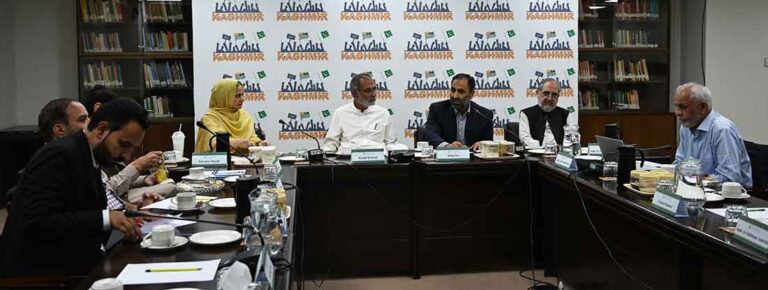
  • IPS Working Group on Kashmir Deliberates on Contemporary Situation and Way Forward

    The Institute of Policy Studies (IPS) organized an in-house discussion on the contemporary situation in Kashmir on September 17, 2026, bringing together members of its Working Group on Kashmir to examine recent developments and deliberate on ways to strengthen political, diplomatic, legal, and intellectual engagement on the Kashmir issue. The participants included Khalid Rahman, Chairman, IPS; Amb. (r) Syed Abrar Hussain, Vice Chairman, IPS; and members of the IPS Kashmir…

  • Who Are the Houthis? From a Ragtag Militia to a Regional Power Broker

    This analysis by Dr. Tughral Yamin, Senior IPS Associate, examines the Houthis’ transformation from a Yemeni insurgency into a regional strategic power. The policy insight explores their military capabilities, Iranian support, strategic control of the Bab al-Mandeb, and growing ability to threaten Saudi Arabia and international shipping. It also highlights the reported use of artificial intelligence in weapons development and the wider implications for Middle Eastern security. Importantly, the analysis…

  • Media, Nafrat aur Tabaqati Taqseem: Manfi Asraat Se Tameeri Hal Tak

    Media profoundly shapes public perceptions, attitudes, and social divisions. Sensationalism, stereotypes, clickbait, and algorithm-driven echo chambers can deepen hatred and class disparities. However, media can promote social cohesion through solutions journalism, diverse editorial teams, responsible entertainment, media literacy, and constructive public dialogue. Technology companies should address harmful algorithmic amplification, while regulators can encourage responsible content through effective frameworks. By prioritizing balanced representation, fact-based reporting, and stories of cooperation, media can…

  • UN Cartography Keeps Kashmir Disputed: Map 4668 Ratified

    This analysis by Dr. Waleed Rasool, Senior IPS Associate, examines the United Nations’ cartographic treatment of Jammu and Kashmir following the 2026 “Correct the Map” resolution. The policy insight clarifies that the resolution neither settles the Kashmir dispute nor transforms the Line of Control into an international boundary. It highlights UN Map No. 4668, which continues to describe Kashmir’s final status as unresolved. Importantly, the analysis argues that India’s unilateral…

Back to top