
Economy

  • Beyond Tax Collection: Towards a Comprehensive Tax Policy for Pakistan

    This analysis by Zafar ul Hasan Almas, former Joint Chief Economist and Senior Research Associate, IPS, and Dr. Asim Ehsan, Senior Research Officer, IPS, examines Pakistan’s need for a comprehensive and transparent tax policy framework. The policy insight explores weaknesses in current tax practices, including reliance on indirect and regressive levies, administrative rule-making, and the exclusion of certain revenues from the divisible pool. It also assesses taxation against principles of…
  • Pakistan’s Economy in Fiscal Year 2025-26: Macroeconomic Stabilization and the Challenge of Sustainable Growth

    This analysis by Zafar ul Hasan Almas, former Joint Chief Economist and Senior Research Associate, IPS; and Dr. Asim Ehsan, Senior Research Officer, IPS, examines Pakistan’s economic performance during FY2025-26, highlighting significant macroeconomic stabilization alongside persistent structural vulnerabilities. The policy insight assesses economic growth, fiscal consolidation, inflation, investment, public debt, and external-sector performance. It notes that while lower inflation, a reduced fiscal deficit, and higher foreign-exchange reserves indicate improved stability,…

  • New Administrative Units in Pakistan: An Economic and Financial Context of the Debate

    This analysis by Zafar ul Hasan Almas, former Joint Chief Economist and Senior Research Associate, IPS, and Dr. Asim Ehsan, Senior Research Officer, IPS, examines the economic and financial implications of creating new provinces or administrative units in Pakistan. The policy insight focuses on five key considerations: resource-transfer mechanisms, the cost of new governance structures, tax administration and the divisible pool, borrowing and contingent liabilities, and the timing of reform.…

  • Is the Era of Dollar Dominance Coming to an End?

    The debate over de-dollarization has moved past academic circles into central banks, finance ministries, and boardrooms worldwide. Sanctions, geopolitical tensions, BRICS’ growing footprint, a shift toward local-currency trade, central banks stocking up on gold again, and new digital payment technologies have all reignited the question of whether US dollar dominance is nearing its end. The article stresses this question deserves a more careful answer than most headlines offer — while…

  • USD 10 Billion Exchange Stabilization Fund Request: Economic and Political Implications for Pakistan

    Pakistan has requested a USD 10 billion loan from the US under the Exchange Stabilization Fund (ESF), a specialized but relatively less prevalent funding mechanism. So far, government officials from either country have not formally acknowledged the request. This IPS Insight examines the funding facility, the rationale for the loan, its potential uses, and its economic, political, and regional implications for Pakistan. Download PDF

  • Federal Budget 2026-27: Overview and Economic Implications

    The brief focuses on the description of the major economic numbers in the Federal Budget 2026-27, while highlighting key details and their implications. It also discusses the impact of the proposed budget on economic development, social welfare, and how well it truly reflects the country’s long-term economic plans. Download PDF

  • Pakistan’s Economy and Upcoming Federal Budget: Challenges and Policy Efforts

    Pakistan’s economy is passing through a critical phase marked by fragile macroeconomic stabilization alongside deep-rooted structural vulnerabilities. The forthcoming federal budget for 2026-27 assumes heightened significance as the country navigates inflationary pressures, external sector risks, IMF conditionalities, and growing demands for inclusive development. This policy brief examines the current state of the economy, outlines the key challenges confronting the budget, and presents policy recommendations aimed at shifting economic management from…

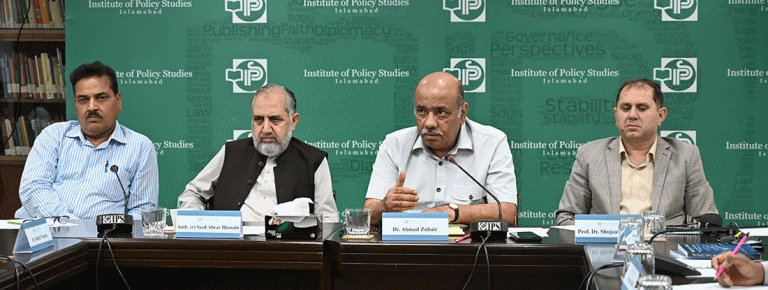
  • Pakistan requires development-focused budget beyond short-term stabilization: IPS seminar

    Pakistan’s upcoming federal budget must move beyond short-term economic stabilization and focus on long-term development priorities including export growth, investment promotion, food security, and reduction in poverty and inequality. Without political will, institutional coordination, structural reforms, and reliable economic data, the country may continue to face stagflation, widening inequality, and growing balance-of-payments pressures. The aforementioned views were expressed by economists and fiscal experts during a discussion on the federal budget…

  • Pakistan Economic Insights (October-November 2025)

    Pakistan’s economy in the first six months of FY2025-26 shows a mixed picture of resilience amid mounting strain. Though fiscal consolidation, monetary steadiness, and growth in manufacturing (e.g., automobiles, cement) indicated fundamental fortitude, noteworthy vulnerabilities are increasing. The most serious compression point is the weakening agriculture sector, which grew merely at 0.56% in FY25, intimidating food security and inflation. Simultaneously, the external sector is fading, with a broadening current account…

Back to top