


Pakistan Affairs

  • Is the Era of Dollar Dominance Coming to an End?

    The debate over de-dollarization has moved past academic circles into central banks, finance ministries, and boardrooms worldwide. Sanctions, geopolitical tensions, BRICS’ growing footprint, a shift toward local-currency trade, central banks stocking up on gold again, and new digital payment technologies have all reignited the question of whether US dollar dominance is nearing its end. The article stresses this question deserves a more careful answer than most headlines offer — while…
  • Federal Budget 2026-27: Overview and Economic Implications

    The brief focuses on the description of the major economic numbers in the Federal Budget 2026-27, while highlighting key details and their implications. It also discusses the impact of the proposed budget on economic development, social welfare, and how well it truly reflects the country’s long-term economic plans. Download PDF

  • Pakistan’s Economy and Upcoming Federal Budget: Challenges and Policy Efforts

    Pakistan’s economy is passing through a critical phase marked by fragile macroeconomic stabilization alongside deep-rooted structural vulnerabilities. The forthcoming federal budget for 2026-27 assumes heightened significance as the country navigates inflationary pressures, external sector risks, IMF conditionalities, and growing demands for inclusive development. This policy brief examines the current state of the economy, outlines the key challenges confronting the budget, and presents policy recommendations aimed at shifting economic management from…

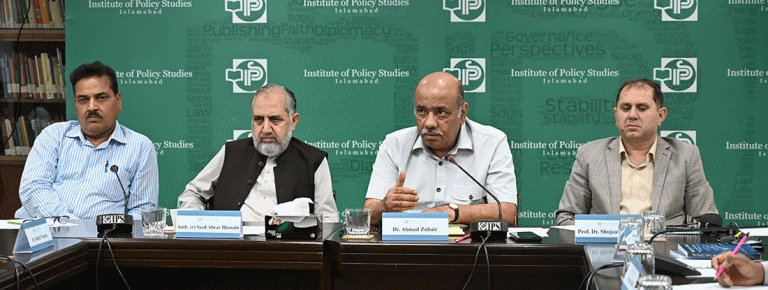
  • Pakistan requires development-focused budget beyond short-term stabilization: IPS seminar

    Pakistan’s upcoming federal budget must move beyond short-term economic stabilization and focus on long-term development priorities including export growth, investment promotion, food security, and reduction in poverty and inequality. Without political will, institutional coordination, structural reforms, and reliable economic data, the country may continue to face stagflation, widening inequality, and growing balance-of-payments pressures. The aforementioned views were expressed by economists and fiscal experts during a discussion on the federal budget…

  • Pakistan Economic Insights (January 2026)

    Pakistan’s economic recovery is gaining momentum faster than anticipated, with large-scale manufacturing rebounding from contraction to 4.8% growth and agriculture expected to contribute positively. Fiscal consolidation of Rs. 2 trillion was achieved primarily through Rs. 1.6 trillion interest payment savings following rate reductions. However, external pressures are mounting as imports surge while exports contract sharply, widening the trade deficit. Remittances remain the only saving grace. Paradoxically, despite massive social protection…

  • Pakistan Economic Insights (October-November 2025)

    Pakistan’s economy in the first six months of FY2025-26 shows a mixed picture of resilience amid mounting strain. Though fiscal consolidation, monetary steadiness, and growth in manufacturing (e.g., automobiles, cement) indicated fundamental fortitude, noteworthy vulnerabilities are increasing. The most serious compression point is the weakening agriculture sector, which grew merely at 0.56% in FY25, intimidating food security and inflation. Simultaneously, the external sector is fading, with a broadening current account…

  • Fund for Responding to Loss and Damage (FRLD): A Roadmap for Pakistan’s Advocacy

    In 2022, Fund for Responding to Loss and Damage (FRLD) was established as a landmark outcome of COP 27. It is largely seen as both a financial instrument and mechanism of delivering climate justice globally for climate vulnerable developing countries. With increasing reality of climate change and its severe impacts in the future, the need for equitable, sustainable and easily accessible loss and damage finance has become crucial. The policy…

  • Pakistan Economic Insights: First Quarter of Fiscal Year 2025-26

    Pakistan’s economy in the first quarter of fiscal year 2025-26 (July-September 2025) shows signs of regaining, with growth reviewed up to 3.0% for FY25, reinforced by positive commendations from international credit rating agencies (Moody’s, Fitch, S&P) and the successful completion of an IMF review. However, this delicate retrieval faces substantial headwinds from overwhelming monsoon floods, which have harshly impacted agriculture, caused inflationary burdens, and stressed fiscal and external accounts. Crucial…

  • Pakistan Economic Insights (July-August 2025)

    Pakistan’s economy in the first two months of fiscal year 2025-26 (July-August 2025) displayed a mixed outlook, characterized by cautious confidence following credit rating enhancements but outshined by other noteworthy issues and challenges. Moody’s elevation to Caa1 reflects growth under the IMF program, strengthened by better external cushions and fiscal consolidation. Major segments demonstrate progress: manufacturing, predominantly cement and automobiles, displayed sturdy development, and inflation has toned down meaningfully from…

  • Reforming NTDC: Addressing Transmission Challenges and Advancing Market Liberalization

    On September 13, 2024, a committee comprising the Minister for Power, the Minister for Economic Affairs, the Secretary of the Power Division, and the Chairman of the NTDC Board of Directors presented a restructuring plan for NTDC to the Prime Minister. The Federal Cabinet approved the plan in November 2024, with implementation aimed for June 2025. The plan, as part of a broader set of sectoral reforms, aims to enhance…

Back to top