
Policy Insights

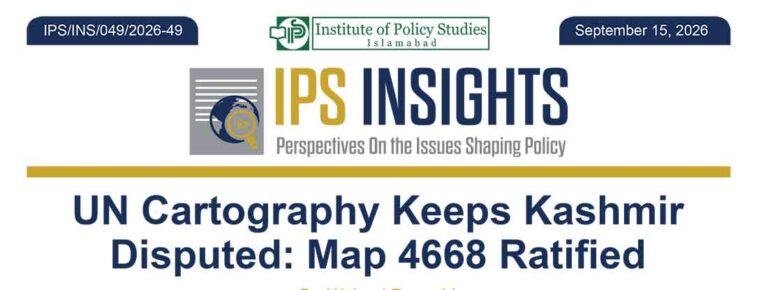
  • UN Cartography Keeps Kashmir Disputed: Map 4668 Ratified

    This analysis by Dr. Waleed Rasool, Senior IPS Associate, examines the United Nations’ cartographic treatment of Jammu and Kashmir following the 2026 “Correct the Map” resolution. The policy insight clarifies that the resolution neither settles the Kashmir dispute nor transforms the Line of Control into an international boundary. It highlights UN Map No. 4668, which continues to describe Kashmir’s final status as unresolved. Importantly, the analysis argues that India’s unilateral…
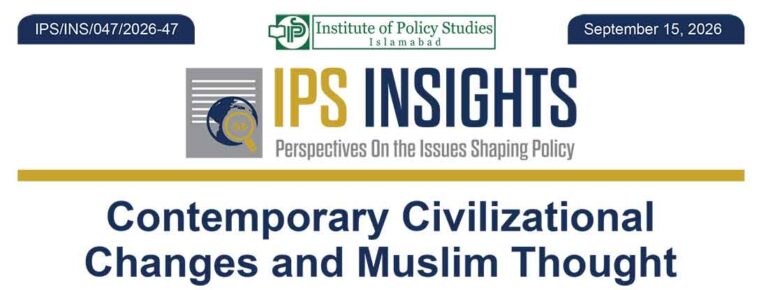
  • Contemporary Civilizational Changes and Muslim Thought

    This analysis by Prof. Dr. Anis Ahmad, Member of the National Advisory Council, IPS, examines contemporary civilizational changes and their impact on Muslim thought and societies. The policy insight explores Western civilizational dominance, intellectual subjugation, and the need to positively articulate Islamic culture based on the Qur’an, Sunnah, and history while critically analyzing the foundations of Western thought. It also identifies key priorities, including addressing skepticism, Islamophobia, ethical relativism, family…

  • Contemporary Civilizational Changes and Muslim Thought (Urdu version)

    This analysis by Prof. Dr. Anis Ahmad, Member of the National Advisory Council, IPS, examines contemporary civilizational changes and their impact on Muslim thought and societies. The policy insight explores Western civilizational dominance, intellectual subjugation, and the need to positively articulate Islamic culture based on the Qur’an, Sunnah, and history while critically analyzing the foundations of Western thought. It also identifies key priorities, including addressing skepticism, Islamophobia, ethical relativism, family…

  • Sanctions on Settlements: Signal or Symbolism?

    This analysis by Brig (r) Dr. Tughral Yamin, Senior IPS Associate, examines the significance and limitations of Western trade measures targeting Israeli settlements in the occupied West Bank. The policy insight explores whether these measures represent meaningful economic pressure or political symbolism, highlighting their limited scope, enforcement challenges, and potential political backlash in Israel. It also assesses the distinction between settlement-related sanctions and the broader military campaign in Gaza, particularly…

  • October 7: Did Netanyahu Know—and, If So, Why Did He Not Act?

    This analysis by Dr. Tughral Yamin, Senior IPS Associate, examines the question of whether Israeli Prime Minister Benjamin Netanyahu received prior warning of the October 7, 2023 Hamas attack and, if so, how the information was handled. The policy insight explores the alleged UAE warning, existing intelligence about Hamas preparations, and the role of strategic complacency and flawed assumptions in the failure to prevent the attack. It also distinguishes political…

  • Beyond New Provinces: Rethinking Pakistan’s Governance Crisis (Urdu Version)

    The debate over creating new provinces has resurfaced as a proposed remedy for Pakistan’s governance challenges. However, administrative restructuring is only one component of a much broader governance agenda. Effective governance depends on accountable institutions, representative politics, empowered local governments, and the consistent implementation of constitutional principles. This article examines why Pakistan’s governance crisis demands comprehensive political and institutional reforms rather than relying solely on changes to provincial boundaries. Download…

  • Pipeline Politics in Afghanistan: The Great Game Returns

    This analysis by Dr. Tughral Yamin, Senior IPS Associate, examines the renewed geopolitics of energy and connectivity in Afghanistan following a $200 million Saudi-linked hydrocarbon agreement and the proposed Herat–Spin Boldak gas pipeline. The policy insight traces the historical evolution of pipeline politics from Bridas, Unocal, and CentGas to the present initiative, while assessing Afghanistan’s potential transition from an energy transit state to an energy producer. Download PDF

  • Pakistan-Afghanistan Relations: From Strategic Patience to Strategic Recalibration

    This analysis by Dr. Tughral Yamin, Senior IPS Associate, examines Pakistan-Afghanistan relations amid growing tensions over terrorism, border management, trade, refugees, and diplomatic mistrust. The policy insight explores the limitations of military pressure and the need to balance deterrence with dialogue, respect for sovereignty, and economic interdependence. It also assesses Afghanistan’s expanding regional relationships and China’s potential role in facilitating engagement. Importantly, the insight advocates reviving the Urumqi process as…

  • Beyond Tax Collection: Towards a Comprehensive Tax Policy for Pakistan

    This analysis by Zafar ul Hasan Almas, former Joint Chief Economist and Senior Research Associate, IPS, and Dr. Asim Ehsan, Senior Research Officer, IPS, examines Pakistan’s need for a comprehensive and transparent tax policy framework. The policy insight explores weaknesses in current tax practices, including reliance on indirect and regressive levies, administrative rule-making, and the exclusion of certain revenues from the divisible pool. It also assesses taxation against principles of…

  • Iran-US War: Strategic Dynamics, Constraints, and the Elusive Endgame

    This analysis by Said Nazir, Senior IPS Associate, examines the strategic dynamics, constraints, and uncertain endgame of the Iran-US war. The policy insight explores US war aims, Iran’s asymmetric strategy, the strategic importance of the Strait of Hormuz, and the economic and political costs of the conflict. It also assesses the limitations of American military power, global commitments, and the absence of a viable ground-war option. Importantly, the commentary highlights…

Back to top