
Policy Insights

  • Five Years On: Assessing Governance, Stability and Foreign Relations under Taliban Rule

    This analysis by Syed Abrar Hussain, Vice-Chairman IPS and the former ambassador of Pakistan to Afghanistan, assesses five years of Taliban rule, focusing on governance, economic survival, social restrictions, regional geopolitics, and relations with neighboring countries. The respective policy insight compares the incumbent Taliban administration with its previous rule, highlighting its greater administrative capacity, revenue generation, and regional diplomatic engagement, while noting the persistence of ideological rigidity, restrictions on women,…
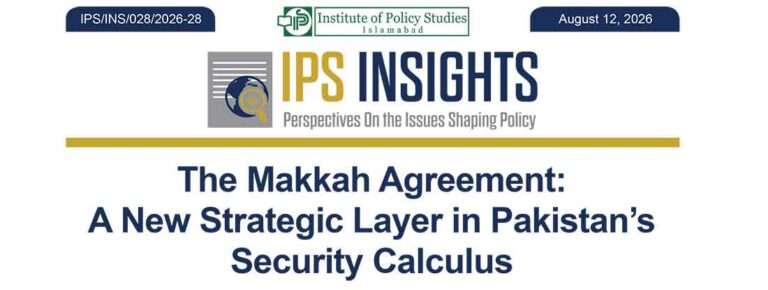
  • The Makkah Agreement: A New Strategic Layer in Pakistan’s Security Calculus

    This analysis by Brig (r) Tughral Yamin, Senior IPS Associate, examines the strategic significance of the Makkah Joint Defense Agreement signed by Pakistan, Saudi Arabia, and Türkiye and its implications for Pakistan’s security calculus. The policy insight explores how the trilateral pact adds another layer to Pakistan’s defense posture amid changing regional security dynamics and growing doubts about the reliability of the US security role in the Middle East. It…

  • Five Years On: Assessing Governance, Stability and Foreign Relations under Taliban Rule

    This analysis by Dr Lutfur Rahman, Senior Research Fellow at IPS, assesses five years of Taliban rule in Afghanistan from academic perspective, examining the balance between relative security gains and the country’s continuing domestic and regional challenges. The policy insight explores the Taliban’s reduction of large-scale violence and opium cultivation alongside Afghanistan’s worsening humanitarian conditions, healthcare and shelter needs, restrictions on women and minorities, and reports of extrajudicial killings. It…

  • From Gaza to Iran: Where Is the Dignified Way Out of War?

    This analysis by Masood Abdali, senior IPS Research Associate, examines the search for a political and diplomatic exit from the ongoing wars in Gaza and Iran. The respective IPS insight explores Hamas’s conditional willingness to disarm and relinquish administrative control in Gaza, the political dilemma facing Israel, and growing concerns within the US leadership over the limits of military action against Iran. It highlights the narrowing space for military solutions…

  • Pakistan–Saudi Arabia–Turkiye Defence Pact: Towards a New Regional Security Architecture or a Limited Strategic Understanding?

    The article analyzes the emerging Pakistan–Saudi–Türkiye defence pact, an extension of the 2025 Pakistan-Saudi SMDA, driven by waning trust in US security guarantees and rising Iranian threats. Pakistan brings manpower and nuclear deterrence, Türkiye adds defence industry and naval strength, while Pakistan also plays diplomatic bridge between Riyadh and Tehran. Though a mutual-defence clause exists, the author argues it falls short of NATO’s Article 5, likely activating only in specific…

  • The Changing Character of War: Towards a New Global Security Architecture

    This analysis by Said Nazir, senior associate, IPS, examines the changing character of modern warfare and its implications for the future of global security architecture. The policy insight explores how the Ukraine war, the Iran-US/Israel conflict, and the Gaza crisis have exposed the limitations of the traditional alliance-based security order and challenged the effectiveness of overseas military deployments. It highlights the growing role of missiles, drones, cyber capabilities, and hybrid…

  • Is the Era of Dollar Dominance Coming to an End?

    The debate over de-dollarization has moved past academic circles into central banks, finance ministries, and boardrooms worldwide. Sanctions, geopolitical tensions, BRICS’ growing footprint, a shift toward local-currency trade, central banks stocking up on gold again, and new digital payment technologies have all reignited the question of whether US dollar dominance is nearing its end. The article stresses this question deserves a more careful answer than most headlines offer — while…

  • Can the United States Still Defend Israel? Strategic Limits of American Military Capacity

    The IPS Insight by Brig (r) Dr Tughral Yamin argues that while the United States remains the world’s strongest military power, its ability to simultaneously sustain major commitments in Israel, Ukraine, and the Indo-Pacific is increasingly constrained by limited stocks and slow production of advanced missile interceptors. It contends that America’s industrial capacity – rather than military capability – has become the decisive strategic challenge, raising doubts about its long-term…

  • Towards an Architecture of Intelligent Civic Response

    Street protest has long been society’s default response to disagreement and injustice — but is it always the right one? In this thought-provoking piece for IPS Insights, Dr. Maria Khalid introduces the concept of “Intelligent Civic Response”: the idea that societies possess finite civic capital — attention, trust, goodwill, energy — and must choose their responses as strategically as they choose their causes. From dialogue and policy engagement to research…

  • USD 10 Billion Exchange Stabilization Fund Request: Economic and Political Implications for Pakistan

    Pakistan has requested a USD 10 billion loan from the US under the Exchange Stabilization Fund (ESF), a specialized but relatively less prevalent funding mechanism. So far, government officials from either country have not formally acknowledged the request. This IPS Insight examines the funding facility, the rationale for the loan, its potential uses, and its economic, political, and regional implications for Pakistan. Download PDF

Back to top